


The ongoing copyright dispute between folk veteran Beautiful Nubia and gospel artiste Yinka Ayefele has taken a fresh turn, as Ayefele appeared to issue a subtle jab referencing a traditional Yoruba folklore song hours after being accused of melody theft.
Recall that Beautiful Nubia, whose real name is Segun Akinlolu, had earlier accused Ayefele and fast-rising singer BBO of copyright infringement.
In a post shared on his X account, the folk icon alleged that Ayefele’s 2012 gospel track My Faith in God (Igbagbo Ireti) and BBO’s 2026 song Amin derived their core melodies from his 1997 song Seven Lifes without permission or credit.
“There was Yinka Ayefele with ‘My Faith in God (Igbagbo Ireti)’ in 2012 and now someone called BBO with ‘Amin’ this year. Both stole their melodies from our original song ‘Seven Lifes’. When will Nigerians (especially the so-called gospel musicians) learn to respect copyright?” Nubia wrote.
However, shortly after the allegation gained traction online, Ayefele shared a cryptic post on his Facebook page that many observers interpreted as a veiled response.
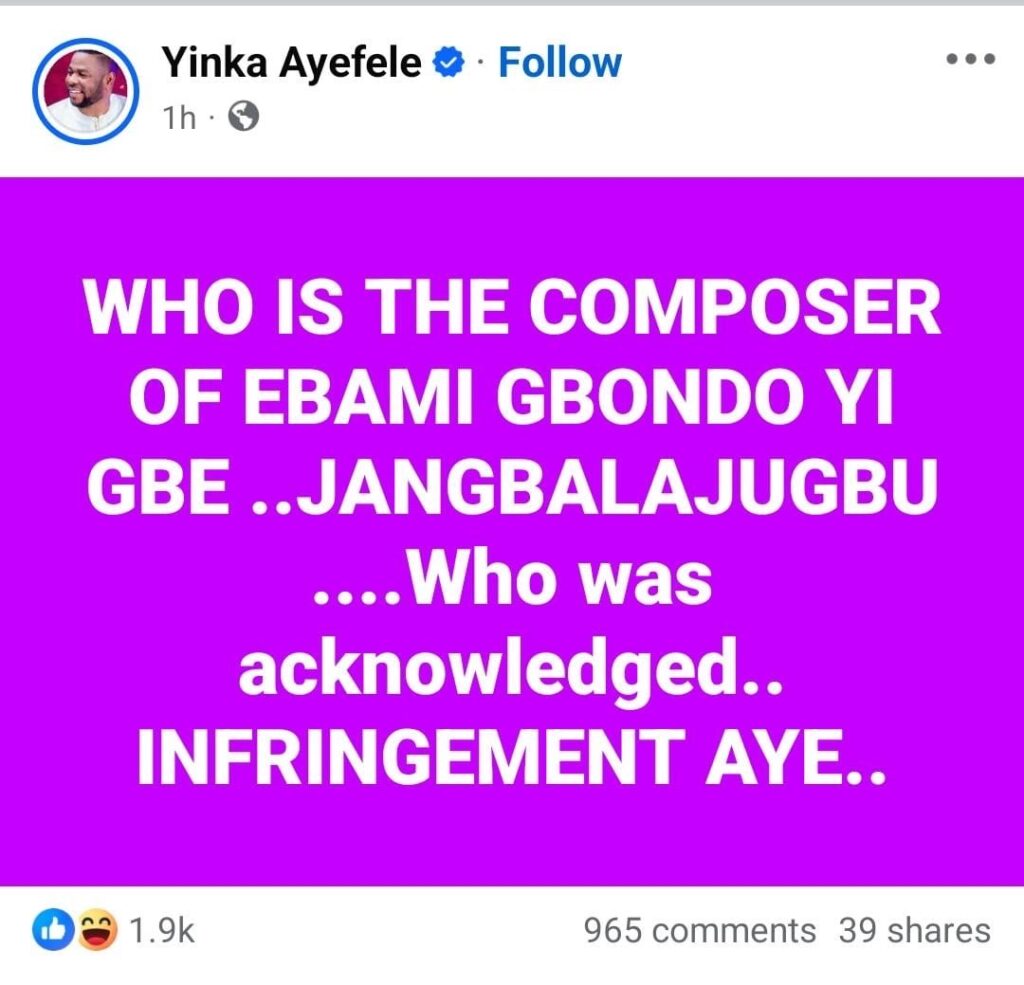
“WHO IS THE COMPOSER OF EBAMI GBONDO YI GBE.. JANGBALAJUGBU … Who was acknowledged.. INFRINGEMENT AYE..,” Ayefele wrote.
This publication understands that The phrase “Gbondò Yi Gbe…Jangbalajugbu” is a Yoruba folklore chant that has existed within oral tradition for decades. The chant was however notably performed and popularised in contemporary folk circles by Beautiful Nubia in the early 2000s during live performances and was later included in his repertoire as part of his effort to revive and reinterpret traditional Yoruba sounds for modern audiences.
While Nubia’s rendition however gained widespread recognition among his fans, the chant itself is generally regarded as a traditional composition without a single traceable modern author.
Ayefele’s rhetorical question has since fueled discussions among fans and critics, with some suggesting that he may be questioning the ownership claims around songs rooted in folklore. Others suggesting that while traditional lyrics may be communal, specific arrangements, melodies and structured recordings can still enjoy copyright protection under Nigerian law.